The Toronto Scottish Regiment (Queen Elizabeth The Queen Mother's Own)
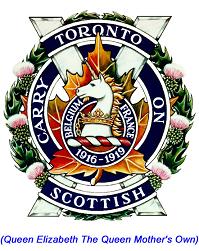
Armorial Description
On a wreath of thistles, the Cross of St. Andrew, charged in the centre
with a maple leaf, both interfacing an annulus inscribed with the motto
CARRY ON; upon a second annulus placed on the centre of the maple leaf
and inscribed BELGIUM FRANCE 1916-1919, a unicom's head couped and
gorged with an antique crown chained, and resting on an heraldic wreath;
on the upper and lower bends of the wreath and resting on the arms of
the Cross two scrolls, the upper inscribed TORONTO and the lower
SCOTTISH.
Official Abbreviation: Tor Scot R
Motto: Carry On
Battle Honours (37)
First World War
SOMME, 1916
AMIENS
Ancre Heights
Scarpe,1918
ANCRE, 1916
DROCOURT-QUTANT
ARRAS, 1917,'18
Hindenburg Line
VIMY, 1917
CANAL DU NORD
HILL 70
VALENCIENNES
Ypres, 1917
Sambre
PASSCHENDAELE
France and Flanders, 1916-1918
Second World War
DIEPPE
South Beveland
BOURGVTBUS RIDGE
THE RHINELAND
ST. ANDRT-SUR-ORNE
THE REICHSWALD
Verrieres Ridge -- Tilly-la-Campagne
Goch-Calcar Road
FALAISE
THEHOCHWALD
Falaise Road
Xanten
Clair Tizon
Twente Canal
Dunkirk, 1944
Groningen
ANTWERP-TURNHOUTCANAL
Oldenburg
THESCHELDT
North-West Europe, 1942,1944-45
WOENSDRECHT
Colonel-in-Chief: Prince Charles
Authorized Marches:
Quick March: Blue Bonnets Over The Border
Regimental Headquarters:
The Toronto Scottish Regiment
70 Birmingham Street
Toronto, ON, M8V 3W6
Order of Precedence: 47
Go back to the Infantry Regiments page.
Go back to the Army home page.
|




 Air-Force.ca Forums