The Nova Scotia Highlanders
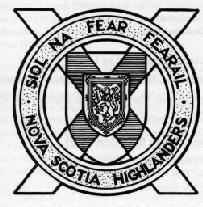
Armorial Description
The Cross of Saint Andrew, in the centre the coat of arms of the province of
Nova Scotia (i.e.: argent, on a saltire azure an ascutcheon of the Royal Arms
of Scotland); encircling the arms an annulus inscribed, on the upper curve
with the motto SIOL NA FEAR FEARAIL, and on the lower curve with the
designation NOVA SCOTIA HIGHLANDERS.
Official Abbreviation: NS Highrs
Motto: Siol Na Fear Fearail (Breed of manly men)
Battle Honours (56)
Early History
First World War
YPRES, 1915,'17
Hill 70
Festubert, 1915
PASSCHENDAELE
MOUNT SORREL
AMIENS
Somme, 1916,'18
DROCOURT-QUEANT
Flers-Courcelette
HINDENBURG LINE
Thiepval
CANAL DU NORD
Ancre Hieghts
Cambrai, 1918
ARRAS, 1917,'18
Valenciennes
VIMY, 1917
Sambre
Arleux
FRANCE AND FLANDERS, 1915-1918
Scarpe, 1917,'18
Second World War
LIRI VALLEY
Falaise
Melfa Crossing
The Laison
Ceprano
CHAMBOIS
GOTHIC LINE
BOULOGNE, 1944
Montecchio
Calais, 1944
CORIANO
The Scheldt
LAMONE CROSSING
Savojaards Plaat
Fosso Munio
BRESKENS POCKET
Conventello-Comacchio
The Rhineland
ITALY, 1944-1945
Waal Flats
Normandy Landing
The Hochwald
AUTHIE
THE RHINE
Caen
Zutphen
The Orne
Ijsselmeer
Bourguebus Ridge
Leer
Faubourg de Vaucelles
Delfzijl Pocket
Verrieres Ridge -- Tilly-la-Campagne
North-West Europe, 1944-1945
Regimental Headquarters:
1st Battalion
The Nova Scotia Highlanders (North)
126 Willow St.
Truro, Nova Scotia
B2M 4Z6
2nd Battalion
The Nova Scotia Highlanders (Cape Breton)
Victoria Park
Sydney, Nova Scotia
B1P 6G8
Order of Precedence: 25
Go back to the Infantry Regiments page.
Go back to the Army home page.
|



 Air-Force.ca Forums